Two different problems get discussed as one, and they need separating before either can be solved.
- Low carbonate hardness is a resolution problem. The method still applies, your test kit just cannot see finely enough for the answer to mean much.
- Aquasoil, peat and pH buffers are a validity problem. The method does not apply at all, and no better test kit fixes that.
Why soil and botanicals break the calculation
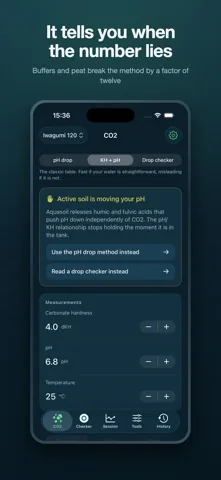
The carbonate route assumes one thing: that the carbonate system is the only thing holding your pH where it sits. Active soils, peat, leaves, alder cones and phosphate based pH down products all hold pH down without contributing carbonate hardness. The equation cannot tell the difference between a proton that came from dissolved gas and one that came from a humic acid, so it reads the whole depression as carbon dioxide.
The size of that mistake is the part people underestimate. In documented soil setups the classic table runs high by a factor of 12 to 19. A tank at 4 dKH and pH 6.5 computes to about 38 ppm when the truth can be 2 to 3. That is not a wide error bar, it is a description of a different tank, and it points you toward exactly the wrong action.
Low carbonate hardness is a different failure
In a soft water scape or a shrimp tank the carbonate assumption may be perfectly sound and the arithmetic still barely useful, because an ordinary drop titration resolves to about half a degree. Carbonate hardness enters the equation linearly, so that resolution is a straight percentage of your answer:
| Carbonate hardness | Share of the result | Practical meaning |
|---|---|---|
| 1 dKH | 50 percent | Order of magnitude only |
| 2 dKH | 25 percent | Order of magnitude only |
| 3 dKH | 17 percent | The boundary, and it stacks on the pH term |
| 4 dKH | 12.5 percent | Workable alongside a decent pH reading |
| 6 dKH | 8 percent | No longer the dominant error |
Below 3 dKH the app flags the result as an order of magnitude rather than a measurement. Softening the water to make a number look better is the wrong direction: the reading did not improve, only your confidence in it.
What to use instead
- The pH drop method. Carbonate hardness cancels out of the ratio entirely, so neither the soil nor the low hardness matters. This is the route to reach for in a soil tank. The full procedure is here.
- A drop checker. The reference fluid inside it is 4 dKH by definition and only gas crosses the air pocket, so your tank's chemistry cannot reach it. The colour bands are here.
- Your livestock and your plants. Surface behaviour and pearling remain the fastest signals in the tank, and neither method above replaces them.
Invertebrates react before fish do, and a small volume swings faster than a large one. The app lets you declare shrimp in the tank, and that declaration lowers the point at which it calls a concentration risky rather than merely high.
An app that stops instead of guessing
Declare your substrate and additives once per tank. When they break the carbonate method, the app locks that path, says which declaration did it, and sends you to the drop checker or a timed pH drop run.