A drop checker is a small glass vessel hanging in the tank, holding a reference solution of known carbonate hardness with bromothymol blue as the indicator, separated from the tank water by a pocket of air. Only gas crosses that pocket. Humic acids, phosphate, nitrate and your fertiliser cannot. Inside the checker the carbonate hardness is therefore known and purely carbonate, which is the one condition under which the pH to CO2 relation holds exactly.
The colour bands
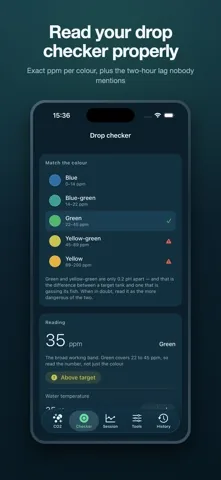
Against a reference solution of 4 dKH. The ppm figures are the working bands the app uses, not decimal claims.
| Colour | Indicator pH | Roughly | Read it as |
|---|---|---|---|
| Blue | above 7.0 | 0 to 14 ppm | Too little, or the checker has not caught up yet |
| Blue green | 6.8 to 7.0 | 14 to 22 ppm | Approaching the usual working range |
| Green | 6.5 to 6.8 | 22 to 45 ppm | The broad working band, and it is broad |
| Yellow green | 6.2 to 6.5 | 45 to 89 ppm | Caution. Watch the livestock now |
| Yellow | below 6.2 | 89 ppm and up | Aerate, and reduce injection |
Green and yellow green are only 0.2 pH apart, and that is the difference between a tank on target and one that is gassing its fish. The response of the indicator is not linear, so when a colour sits between two bands, read it as the more dangerous of the two rather than splitting the difference.
The lag nobody puts on the box
Gas has to leave the tank water, cross the air pocket and dissolve into the reference fluid. Two phase boundaries mean the colour you are looking at is the tank as it was one to two hours ago, and full equilibrium takes four to five hours. After any change to your bubble rate, wait at least three hours before judging the result. Adjusting twice in one day is how livestock is lost.
Why your checker stays blue
This is the single most common beginner thread in the hobby, and the instinctive response to it, turning the gas up, is the one that empties the tank. In order of how often each is actually the answer:
- Not enough time has passed. If it has been under four or five hours since you filled or moved it, the checker has not finished responding. This is the most likely cause and the cheapest to rule out.
- The indicator fluid is old. Bromothymol blue stops changing colour after a few weeks. Remake it.
- Placement or flow. In a dead spot the checker reads that corner rather than the tank. Hang it at mid height on the opposite side from the diffuser.
- Wrong fill level. Too much fluid and the air pocket disappears, which is the entire mechanism.
- Tank water instead of reference solution. Then the reading depends on your tank's hardness and means nothing.
The 4 dKH reference solution
The value 4 dKH is a definition, not a measurement, which is why the checker does not care what your tank's hardness is. To make it: dissolve about 0.12 g of sodium bicarbonate per litre of distilled water, then add bromothymol blue as the indicator. For a small 500 ml batch that is about 0.06 g.
Tap water defeats the whole point, because it brings its own hardness and the reference stops being a reference. Remake the fluid every few weeks.
Carry the scale and the recipe with you
The app renders the bromothymol blue scale on screen with each band's ppm, holds the reference recipe, and runs the triage above for a checker that stays blue.